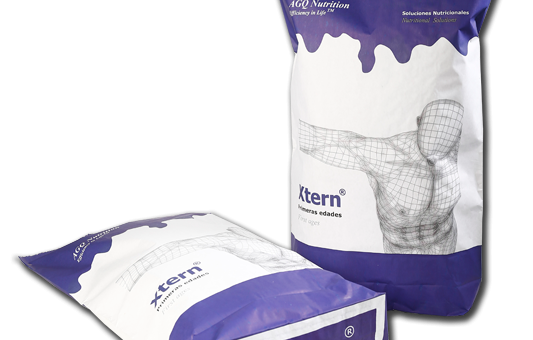
Xtern®
Xtern®
Nutrition for young ruminants around weaning
XTERN® is a formulation for the feeding of young calves, lambs and goat kids in the weeks before and after weaning. A carefully formulated blend of ingredients and feed additives, it is designed to accompany young ruminants in the change from milk to solid feed.
Tailored specifically for the weeks before and after weaning, XTERN® is part of a feeding programme in which the young animal gradually moves from milk feeding to a diet based on solid feed.
Specifications
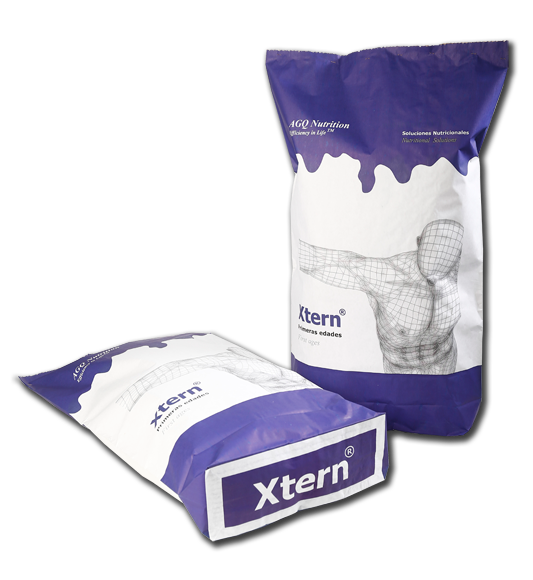
Xtern® at a Glance
From Milk to Solid Feed
Weaning programmes aim to move young ruminants from milk or milk replacer to solid feed at the right time, which also has an impact on rearing costs. Xtern® has a milky aroma and a sweet taste, and is designed to be offered to calves from the first weeks of life as part of the weaning programme.
Designed for Young Ruminants
Xtern® is intended for calves, lambs and goat kids with a normal health status, in the weeks before and after weaning, and is used following the instructions on the label.
Rumen Development
At birth, the young ruminant digests milk much like a monogastric animal. As it starts to eat solid feed, the rumen develops progressively and the fermentation of feed produces short-chain fatty acids, which gradually become a main source of energy. Weaning is the stage in which this natural change takes place.
Aroma & Taste
- Milky aroma.
- Part of the weaning programme.
- For the first weeks of life.
- Sweet taste.
Target Animals
- For calves, lambs and goat kids.
- With a normal health status.
- In the weeks before and after weaning.
- Used as indicated on the label.
Rumen Development
- The rumen develops as solid feed is introduced.
- Fermentation produces short-chain fatty acids.
- Weaning is a natural transition.
- Good weaning planning supports the productivity of the farm.
Science & Practice
Calves are born with a physically and metabolically underdeveloped rumen and initially rely on milk to meet their nutrient needs.
The newborn calf,
Khan et al., J. Dairy Sci. 2016The change from milk to solid feed involves solid feed intake, rumen microbes, rumen fermentation, growth of the rumen papillae and the development of rumination.
From milk to solid feed,
Khan et al., J. Dairy Sci. 2016In ruminants, a considerable part of the energy comes from short-chain fatty acids produced by rumen fermentation.
Rumen fermentation,
Bergman, Physiol. Rev. 1990The first calf paper in the Journal of Dairy Science, published in 1919, described factors affecting the birth weight of calves of different breeds.
A century of research,
Kertz et al., J. Dairy Sci. 2017Early weaning was already studied in the first decades of calf research, as a way to conserve the milk fed to calves.
Early weaning,
Kertz et al., J. Dairy Sci. 2017Feed good-quality colostrum as soon as possible after birth.
Practical tip,
(AGQ Nutrition)Offer clean, fresh water from the first days of life.
Practical tip,
(AGQ Nutrition)Make starter feed available from the first week of life and keep it fresh (AGQ Nutrition).
Practical tip,
Reduce milk gradually in the weeks before weaning rather than stopping it abruptly (AGQ Nutrition).
Practical tip,
Base the weaning decision on starter intake, not only on age (AGQ Nutrition).
Practical tip,
Weigh calves at birth and at weaning to follow their growth.
Practical tip,
AGQ NutritionAvoid combining weaning with other changes, such as moving or regrouping, on the same day.
Practical tip,
(AGQ Nutrition)Ask AGQ Nutrition for support when designing your weaning programme.